
3.2 Future of CBR in the Asia -Pacific Region
| CBR is considered as the most significant innovation over the last quarter century for people with disabilities, especially for those in rural areas in developing countries. The positive benefits of CBR are documented in evaluation studies from different countries. The term “CBR” is now a strong brand in itself, recognised all over the world. It is arguably the only “brand” that has survived for such a long time in the development sector. | 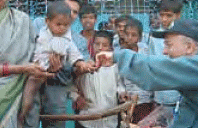 |
CBR was initially promoted as a service delivery method with a medical/rehabilitative focus, for the large numbers of persons with disability from developing countries that had limited resources to address the needs of their disabled citizens. As CBR evolved and matured, there were major changes in the way it was practiced, from a medical orientated, often single-sector approach, to a comprehensive, rights-based approach, based on community development principles. CBR today is understood by most stakeholders in the disability sector as a strategy to promote inclusion, rights and equal opportunities for people with disabilities. Measures for “rehabilitation” and “impairment correction” are an equally important part of CBR, especially from a developing country perspective where there are still areas with minimal services for people with disabilities.
 |
Apart from vertical CBR programmes, the twin track approach, which promotes inclusive development while addressing particular needs of people with disabilities, is also an increasingly accepted strategy. This approach is becoming evident in current CBR trends, where CBR projects address the special needs of people with disabilities, and promote their inclusion in all mainstream development processes and activities. |
No doubt there are CBR practitioners in some parts of the developing world who still see it as only a service delivery, “impairment correction” approach. What is needed is education - for older CBR practitioners and for groups that are against CBR for reasons of their own - on the developments, current understanding and practice related to CBR, and to retain the same term that is well recognized and accepted in the disability sector in developing countries.
-------------------------------------------------------------------------------------------------------------------------
Interview corner
-------------------------------------------------------------------------------------------------------------------------
What is unique in CBR in Asia-Pacific?
Mr. Balakrishna Venkatesh, India:
This region is unique because of the action programs on disability over two decades. One of the results is APCD and the other is Biwako Millennium Framework (BMF). The active participation of DPOs in CRPD and legislations on disability are significant. The stock taking of these developments will tell the true story. The melody of the disability sector is that it is always inward looking and carries on with its task with little heed to the external environment. Before we consider the future of CBR, we need to recognize how the world is changing. Rural areas are being enveloped into the urbanization process. Nature of communities is changing. The concept of development is also changing. Development is seen in the parameter of business - generating surplus to pay for itself, privatization of public services, removal of subsidies and so on. The urbanization process is faster in this region than in Africa and Latin America. The economic recession will also have a bearing on redefining CBR.
Ms. Venus Ilagan, Philippines:
Asia-Pacific is very unique in the sense that we have a social support structure. We have extended families who are happy to support persons with disabilities and see them go through different processes and stages of life. So the family support that is commonly seen in Asia is very important and it’s not being seen in other parts of the world. So it’s one of the strengths that we have in Asia, family support.
Mr. Chapal Khasnabis, India:
| The Asia-Pacific region has a rich history of CBR. It also has a great cultural history of staying together, living together, family values, and community values. In that way, it is much easier in Asia-Pacific to secure inclusion and participation of persons with disabilities. |  |
-------------------------------------------------------------------------------------------------------------------------
Summary of Discussions and Recommendations
-------------------------------------------------------------------------------------------------------------------------
The CRPD came into force in 2008. The CRPD understands disability as resulting from the complex interaction between impairments, structural barriers posed by society and attitudinal barriers based on negative stereotypes about persons with disabilities. This is the most significant development in the disability sector, and the future of CBR lies in working in line with the CRPD. Especially in rural and remote areas, CBR, in partnership with DPOs has a strong role to play in educating people with disabilities, their families and communities about the CRPD, and in advocating with governments to make sure that the CRPD is signed, ratified and implemented.
In many countries, CBR continues to be seen as a single sector (usually health), service delivery mechanism. In these areas, CBR has to change to become a broad-based, comprehensive, rights-based inclusive approach that focuses on empowerment of persons with disabilities who need to play a more central role in CBR.
 |
“CBR’s direction in the future should be comprehensive development, a mainstreaming in development. With this comprehensive development, persons with disabilities will be empowered. When we focus on a social model alone, people may think that the person with severe disabilities will be left out of the CBR programme. So then, we focus on all three, we combine three approaches; medical model, welfare and support model and social model, so that CBR can benefit the most vulnerable group, the poorest person, the person with severe disabilities.” |
There is a need to improve the current understanding of CBR among stakeholders, particularly the governments that still perceive CBR as a service delivery method. All sectors and levels within the government need to be involved in promoting CBR.
| “In my country, the government’s idea on CBR is still on paper, so that has to translate into action”. “Government support is very important for sustainability, at the same time, government should support, not control.” |
 |
“Everybody who is doing the programme for people with disabilities, they said they are doing CBR; we are doing CBR, so it makes people very confused. So I think we need to disseminate the new concept of CBR to everybody at the grassroot level.”
“I noticed that some of the presenters at Congress regard us persons with disabilities as patients. So, I think we must clarify to all the service providers that we are not patients. Because if they will continue to regard people with disabilities as patients, there can be no equal participation. There will be no equal partnership. So, you must understand that we are not patients, because whenever there are patients and a professional relationship, then there is always the superiority. So, you must understand that people with disabilities are not patients and the services we need are services and we are service users.”
The future of CBR also lies in partnerships, especially with DPOs and with governments. CBR cannot exist in isolation and needs to build partnerships with different key stakeholders to achieve the goals of inclusion and empowerment of persons with disabilities. In this context, partnerships with families of persons with disabilities are also to be emphasized. Families are an extremely valuable resource in CBR and CBR needs to utilize and strengthen this resource. At the community and grassroot level, SHGs of persons with disabilities and their families need to be facilitated and their capacity built.
“If we start any CBR programme in any country in the future, we need to adopt a twin-track approach in which we can involve persons with disabilities, plus government and all the stakeholders on the same level.”
| Coverage of CBR in many countries is restricted to some rural areas. CBR should be promoted in poor urban communities and in remote areas (mountainous areas for example), where the need is often the greatest. Appropriate strategies need to be developed for CBR in these areas.
There is a need to look at how to apply CBR principles and practice in other contexts, for example, in disaster management strategies, and to go beyond the purely medical relief activities. |
 |
“When we established CBR and resource information centers in earthquake-affected areas we were thinking of the sustainability of the CBR programme. So, at that time we involved the government representatives in our programme and we asked them to make a combined programme in the earthquake-affected area. But the big problem was that they all considered the medical aspect only. And they organized a medical camp in the earthquake affected area for persons with disabilities. They still treated them as patients or like diseases, so that was the first problem we have faced”.
Capacity building on CBR is necessary for all stakeholders. Lateral learning and experience sharing with different countries in the Asia Pacific region is to be encouraged; for example, ASEAN countries have more experience in CBR which central Asian countries can benefit from.
Future CBR programmes need to look more specifically at how to work with children with disabilities, especially children with intellectual or multiple impairments and their families. CBR also needs to involve and support women with disabilities.
CBR programmes need to utilize and apply Information Communication Technology (ICT) in the future.
 |
Although the available body of literature supporting CBR today is largely from published and unpublished reports of evaluation of CBR in different countries, these reports have clearly demonstrated the utility and benefits of CBR in addressing the needs of persons with disability, and in empowering them in different ways. The future growth of CBR will need more empirical research studies to prove its benefits and build up a factual base for its effectiveness. |
-------------------------------------------------------------------------------------------------------------------------
Interview corner
-------------------------------------------------------------------------------------------------------------------------
What are the future directions for CBR in the Asia Pacific Region?
Mr. Chapal Khasnabis, India:
 |
CBR is practiced in all regions but in different ways. You can see many different features of CBR. So to maximize CBR in the Asia-Pacific region, CBR implementers and its supporters need to come together, share and exchange ideas, expertise and resources, and learn from different experiences of CBR, poverty reduction initiatives, and community development initiatives within the region and also from Africa and other regions. A strong and active CBR Asia Pacific Network will be the torch-bearer in the coming years to achieve this. |
Ms. Christina Parasyn, Australia:
For me, CBR is about partnerships between people in the community - all people - from individuals to families, communities and governments. Most importantly, CBR is about a society where persons with disabilities are active and included as equal citizens and enjoy the benefits of a healthy community just like others.
The Australian Government in November 2008 launched “Development for All: Towards a Disability-Inclusive Australian Aid Program 2009-2014”. The primary outcome of the strategy is the improved quality of life of persons with disabilities. The Australian aid program will also focus on reducing preventable impairments, promoting leadership by persons with disabilities as well as the Australian Government in disability and development, improving AusAID’s capacity to manage an aid program that is inclusive of persons with disabilities, as well as improving the understanding of disability and development.
Ms. Geraldine Pilapil Ruiz, Philippines:
| CBR is not just medical rehabilitation or just teaching children with disabilities how to add one plus one. CBR is to involve persons with disabilities and other stakeholders in a disability agenda. CBR is to be implemented by persons with disabilities mainly, which is the key to empower themselves. |  |